Changes for page NAUJIENOS
Summary
-
Page properties (1 modified, 0 added, 0 removed)
Details
- Page properties
-
- Content
-
... ... @@ -142,44 +142,4 @@ 142 142 143 143 [[image:20200604.png]] 144 144 145 -3. **Standard order forms for suppliers.** 146 - 147 -In StockM supplier card, two new pdf forms in Lithuanian, Russian and English were added to the list of standard order forms: 148 - 149 -• Form F1 replaces the standard rdlcform pdf form. 150 - 151 -• Form F2 additionally includes price and sum. 152 - 153 -(% class="wikigeneratedid" %) 154 -= = 155 - 156 -= StockM Update 2020.05.28 = 157 - 158 - 159 -1. **Resend orders.** 160 - 161 -There are situations when you need to resend the order to the supplier, even the order has been already sent and is in the Placed orders window now. 162 - 163 -It is possible to resend the order by e-mail in the Placed orders window. Clicking on the green envelope in the list next to the desired order will open a window asking if you want to forward it. After confirmation, the program will forward the order according to all its settings. 164 - 165 -This function is also available to resend multiple orders at once – place the checkmark on the desired orders and click „Resend orders“. If the e-mail cannot be sent, the red envelope will light up. 166 - 167 - 168 -2. **Inventory Dynamics report: percentage of lost sales and overstock.** 169 - 170 -Percentages of lost sales and overstock are showed in Inventory dynamics for easier data tracking. 171 - 172 -When you enter with the mouse over a group of columns, a window with values pops up. Next to lost sales and overstock you can see the percentage in parentheses now: 173 - 174 -· lost sales from sales; 175 - 176 -· overstock from inventory. 177 - 178 -This information, like the other fields, can be saved in Excel. 179 - 180 -(% class="wikigeneratedid" %) 181 -= = 182 - 183 -= = 184 - 185 185
StockM Update 2020.08.06
Additional functionality of the right mouse button in StockM.
Additional functionality has been added - new options can be seen in any window by calling up the menu and right-clicking on any row:
- Mark / Unmark selected / outlined rows (if there is no column for the selection in the table, such as in the Periods window, these selections will remain in the menu window, only will be off / in gray color).
It is possible to select all lines of one page, which can be marked / unmarked by calling the menu, by pressing the combination “ctrl + a” in the keyboard.
- 4 new links to windows:
- “Inventories” (with filters: SKU code, Warehouse code). The link will be visible between the options if there is an option to select the SKU code and the Warehouse code in the window where the menu is called;
- “Suppliers schedule” (with filters: Supplier name, Supplier code). The link will be between the selections if there is an option to select the Supplier name and the Supplier code in the window where the menu is called;
- “Suppliers card”. The link will be between the selections if there is an option to select the Supplier name and the Supplier code in the window where the menu is called;
- “SKU card” - product card. The link will be between the selections if there is an option to select an item code in the window where the menu is called.
If the menu is called up in the Inventory window, the Inventory window will not be visible between the selections (same logic as with the Suppliers schedule). The menu item will also not be visible if the user does not have permission to see a specific window.
StockM Update 2020.07.23
1. Entering of the Safety buffers with expiration date (SBX) into StockM.
Until now, safety buffers with dates could be transferred from accounting system to StockM during the data exchange in the file sbx.csv.
Since this update, it is possible to create / edit / delete safety buffers with the expiration date in the StockM window: Time Intervals -> Safety Buffers. They can also be loaded via an excel template.
Creating a New SBX: Time Intervals -> Safety Buffers -> New.
- Only one active combination is possible at a time: SKU - Warehouse - Type (there are 3 types of safety buffer - SBX1, SBX2, SBX3). If you want to load / create an additional period for the same “SKU - Warehouse”, you need to select another type.
- If the combination “SKU - Warehouse - Type” is loaded, which is already active in StockM, it will be changed to the new one.
- When loading items to the window Time Intervals -> Safety Buffers -> New, a maximum of 3 items with the same combination “SKU - Warehouse” can be loaded (or copied) simultaneously, as there are 3 types of safety buffers to date.
- In the window Time Intervals -> Safety Buffers -> New, it is possible to download the template of Safety Buffers. If there are added items in that window, those items will be added to the downloaded template.
- It is possible to load items into the "New safety buffer" window from excel according to the Warehouse code or Warehouse level.
Editing SBX:
- Before the Safety buffer has started - all fields can be edited: Type, Value, Begin date, End date, Remark to safety buffer.
- When the Safety buffer has started but has not expired (or not canceled) - only the fields can be changed: End date, Remark to safety buffer.
- When the Safety buffer has expired or has been canceled - no fields can be changed.
Delete SBX:
- If the Safety buffer has started - after deleting the record, today's date is entered in the "Canceled" column and the validity of the safety buffer is suspended (the Safety buffer remains in the history).
- If the Safety buffer has not yet started - after deleting the record, it is completely deleted from the table, without even leaving it in the history.
2. Transfer of the information of the supplier supplied items (SKU) during data exchange.
So far editing of the information in the window “Supplier info -> Supplier SKU information” took place only in StockM.
Since this update it is possible to transfer information of the Supplier supplied items (SKU) to StockM during data exchange using new file supplier_SKU.csv.
Information transferred to StockM via file is:
- supplier code;
- item code (SKU);
- SKU code in the supplier's ERP;
- SKU name in supplier's ERP;
- SKU unit of measure (dimension) is the supplier's ERP;
- Supplier's minimum ordered quantity - MOQ (by supplier's unit of measure (dimension));
- Quantity of Supplier's minimum unbreakable packaging - USQ (by supplier's unit of measure (dimension));
- Conversion ratio to the supplier's unit of measure (dimension);
- Supplier's purchase price - the price offered by the supplier without VAT per one unit of measurement (dimension) of the supplier, in the base currency. If there is no offer, 0 is displayed;
- Supplier's balance - the free quantity of item in the supplier's warehouse in the supplier's units of measure (dimension).
StockM Update 2020.07.09
Changes in the "Supplier SKU info" window.
In StockM window: Suppliers info -> Supplier SKU info:
1. No warehouse information left in the window. Supplier's product (SKU) information (SKU code in the supplier's system, SKU name in the supplier's system, Unit of measure in the supplier's system, Conversion type and coefficient of Unit of measure) is specified only for a specific SKU and cannot be different in individual warehouses.
2. There are additional information columns for information from the supplier's system: Supplier's MOQ, Supplier's USQ, Supplier's balance, Supplier's purchase price. This information can be entered manually.
StockM Update 2020.06.18
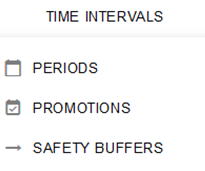
1. New menu window.
A new menu window “Time intervals” has been created in StockM. Moved to it:
• Periods
• Promotions
• Security buffers
2. User activity.
In the SM Admin module is specified activity for the created users (by ticking /or unchecking). Only an active user can log in to StockM.
You can also assign user to a user group Disabled. By indicating this group, the items remained assigned to the person until someone indicated otherwise, but the user himself could not log in to StockM.
Since this update:
• All Disabled users became inactive (one-time change when installing this update);
• All inactive users lose the items (the items are assigned to the Unassigned Manager or to the manager responsible for the incompleted SKU data cards of Unassigned Manager). This can happen both when changing the manager on the items card - during card saving, and when receiving the code of inactive manager during data exchange.
Recommendation for the users:
• When the user no longer works with the program, he needs to be deactivated and all his items will be assigned to an Unassigned Manager or indicated responsible manager instead of Unassigned.
• If you want user to be disconnected temporarily, but the items must remain assigned to him, then assign the user group Disabled.
StockM Update 2020.06.04
1. NEW mover calculation.
NEW mover - a new item mark, which is automatically assigned to all new items that have entered the system (by default, the new items mark is assigned for 3 months after the item appears in the system). It is not logical to assign the same NEW mark when different delivery times are.
Since this update, it is possible to set the method for assigning the New mover mark. In the SM Admin module you can choose:
• how many days after the product card is created in the warehouse it is considered as new (NEW) or
• how many delivery periods (OLT - order lead time) of the item / order it must be considered with the NEW mover mark.
The setting can only be made on a company-wide basis.
2. Zoom function in report graphs.
In the dynamics of buffers and inventory, there was no possibility to zoom / exclude the desired period, as can be done in the item (SKU) graph.
Since this update, this feature was added to the report graphs in StockM in Reports window: Inventory Dynamics, Buffer Dynamics, and Availability (DTA).
When saving to Excel, the period shown in the graph is downloaded.
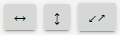
After selecting the fields you want to see, in order to see the updated axes you have to press one of the 'zoom out' buttons (depending on whether you want to see X or Y or X and Y updated axes).
3. Standard order forms for suppliers.
In StockM supplier card, two new pdf forms in Lithuanian, Russian and English were added to the list of standard order forms:
• Form F1 replaces the standard rdlcform pdf form.
• Form F2 additionally includes price and sum.
StockM Update 2020.05.28
1. Resend orders.
There are situations when you need to resend the order to the supplier, even the order has been already sent and is in the Placed orders window now.
It is possible to resend the order by e-mail in the Placed orders window. Clicking on the green envelope in the list next to the desired order will open a window asking if you want to forward it. After confirmation, the program will forward the order according to all its settings.
This function is also available to resend multiple orders at once – place the checkmark on the desired orders and click „Resend orders“. If the e-mail cannot be sent, the red envelope will light up.
2. Inventory Dynamics report: percentage of lost sales and overstock.
Percentages of lost sales and overstock are showed in Inventory dynamics for easier data tracking.
When you enter with the mouse over a group of columns, a window with values pops up. Next to lost sales and overstock you can see the percentage in parentheses now:
· lost sales from sales;
· overstock from inventory.
This information, like the other fields, can be saved in Excel.