Changes for page NAUJIENOS
Summary
-
Page properties (1 modified, 0 added, 0 removed)
Details
- Page properties
-
- Content
-
... ... @@ -1,92 +3,113 @@ 1 -(% class="wikigeneratedid" %) 2 -= StockM Update 2020.05.07 = 3 3 2 += StockM update 2019.11.28. = 4 4 5 -** PTOorders (pto.csv) validity period.**4 +**~ ** 6 6 7 - PTOordersinStockMcanbeenteredmanually or received via pto.csvfrom accounting.6 +**~1. Clarification of Auto send settings in the supplier‘s card.** 8 8 9 -The pto order received so far in StockM could be closed only if it was removed from StockM or if the pto.csv file was not received from accounting. 10 10 11 -Since this update, it is possible to specify the number of days of validity of the pto order „Delete after X days“. The number of days can be entered in StockM, in the PTO orders window, or uploaded via pto.csv file. After the specified number of days after the „Delivery date“, the pto order / quantity will be removed automatically or no longer included in the orders to the supplier. If the field „Delete after X days“ is empty, the order has no expiration date. 12 12 13 -(% class="wikigeneratedid" %) 14 14 15 15 16 16 17 - =StockMUpdate2020.04.30=13 +Selection of Auto send settings window in the supplier‘s card has changed: 18 18 15 +((( 16 +* Optimization for auto send works only into the increasing side; 17 +* If you want to decrease the order – to optimize into decreasing side, this you can do only by specifying the parameters manually. 18 +* To decrease the number of rows to ... – also possible only by specifying the parameters manually. 19 19 20 -**~1. New setting for calculating buffer by coefficient**. 20 + Auto send settings window: 21 +))) 21 21 22 - InthePeriods or Inventory window whencalculatingthe buffer accordingtothe specified coefficient, the bufferis calculated according tothe formula:23 +* Select „No optimization“. 23 23 24 - New BUF = (BUF - MOQ) * coeff.+ MOQ25 +[[image:1_NoOptimization.png]] 25 25 26 -Since this update, this buffer calculation method has a selection / checkbox “Take into account MOQ” that allows you to select to take into account MOQ or not: 27 27 28 -* By default, the check mark is placed and the new buffer calculation formula remains as it was. 29 -* If the check mark is not placed, new buffer formula is: 30 30 31 - NewBUF=BUF *coeff.29 +* Select „Fill transportation batch”. 32 32 31 +((( 32 +[[image:2_FillTransport.png]] 33 +))) 33 33 34 -**2. Calculation of average sales for lost sales.** 35 35 36 - Lostsales are onlycalculatedfor DTA items with a balance≤ 3% (buffer+ safety buffer). It is checkedhow many days a weektheitemsmet this condition andthenumber of days obtained is multipliedby theaveragedaily sales.Average sales are calculated at purchase prices.36 +* Select “Optimize, if the target is not exceeded”. 37 37 38 -Until now, average daily sales have been calculated by taking sales over a three-month period and dividing them by a number of days of 3 months without evaluating whether there was a balance in stock during these days. Average daily sales were inaccurate because there was no balance of some items in stock for the entire period. In other words, they could have counted smaller. 38 +((( 39 +[[image:3_Optimize_.png]] 40 +))) 39 39 40 -To make the calculation of average daily sales more accurate, after the update, they will be calculated by taking sales for a three–month period and diving them by the number of days when the balance or sales were available. 41 41 42 -= StockM Update 2020.04.23 = 43 43 44 44 45 - **~1.Reservationsbydate (pto.csv).**45 +Manual optimization window: 46 46 47 - There are 2 types of reservations in StockM: fromthe existingstock in thewarehouse and special orders from customers (received in StockM via the pto.csv file).47 +[[image:4_pav.png]] 48 48 49 -Since this update, StockM immediately included received pto order in the nearest order to supplier, the date when the order had to be fulfilled was not estimated. In other words, program did not take into account the fact that the customer / buyer does not need these goods now and they can be delivered later with next orders. 50 50 51 -Now StockM will check what delivery date of pto is. In the separate field “Activate before X d.” the number of days before the necessary delivery date can be specified, i.e. when the order must become active and can be already fulfilled. If in the field “Activate before X d.: 52 52 53 -* nothing is specified, the field is empty, the pto order will be processed immediately and it will be included in the nearest order to the supplier; 54 -* 0 is entered, the goods will be ordered with the last order, which will arrive before the specified delivery date; 55 -* certain number of days is entered, the order will become active in such a number of days before the “Delivery date” and will be included in the next order to supplier after this activation. 56 56 57 - (%style="letter-spacing:0.1px"%)**2. VerificationbyuploadingdatatoStockMviaTableL11**.52 +Show the optimization parameter, optimization purpose and optimization condition in this window, when you optimize the order manually. 58 58 59 - When uploading data to StockM via table L11,theinformationwasloadedonlywhen there were noerrors. If the program found errors, the informationwas not loaded. A list ofitemswas displayedto the usernd errorshad to be corrected.54 +**~1. Confirmation of supply graphs.** 60 60 61 - Since this update, informationwillbe loadedfrom those rowsthat do not contain errors, and alist oferrors will be showntotheuser(errorscanbe exported toexcelas before).Oncetheerrorsarecorrected, the data will have tobeuploaded for specified rows once again by enteringinformation into a new/separate L11 tabletemplate.56 +There is a possibility to import the supply graphs in StockM, from the accounting (file scheduler.csv). 62 62 58 +All recieved supply graphs from the accounting are confirmed automatically by system, after update. 63 63 64 -** 3.NewfilteringoperatorinStockM windows.**60 +**2. Template of promotion import.** 65 65 66 - Anadditionalxtfieldfilteringoperator hasbeenaddedto StockM. Itallows to specify / enterseveral values viaa semicolon.62 +The template of promotion import has changed after update. 67 67 68 - [[image:operator_EN.PNG]]64 +Download the newest template from StockM, if you want to import data into promotion. 69 69 70 -= StockM Update 2020.04.09 = 71 71 72 72 73 - 1.**Combining of items intoa groupofalternative(ALT) items.**68 += StockM update 2019.09.19. = 74 74 75 - Untilnow, when combining items into the ALT product group,the main itemhad to beinall active warehouses, andthe ALTproduct wasnot necessarilypresent.70 +**Critical error: "Optimization: purchase price <= 0"** 76 76 77 - This situationcreatedproblems in the distributionofitemsfromthecentralwarehouse to the branches. Whenit wasnecessaryto orderaproduct from a centralwarehouse,an ALTproduct wasofferedto betransportedto the branchif therewas a sufficientALT productbalanceincenterand it wasnotcheckedthat thebranchdoes notselltheALT product.72 +When order is optimized according the amount, purchase prices are checked and if the active goods/items don't have the purchase price, the order is not optimized. 78 78 79 - Since thisupdate,themain and alternative items’codesmustbeinallstoragelocationstocombineALT items.74 +The list will show items with Purchase Price <= 0 for suppliers, for which is set order optimization according the amount. 80 80 81 - Awarning has been made inthe confirmation window ofcombining when saving settings that both main and alternative items will be distributed through the warehouses. Distribution takesplace through all warehouses containing at least oneproduct involved in the ALT combination. Themessage after combining of items will show how many new items (SKU) cards have been created through the warehouses.76 += StockM update 2019.08.01. = 82 82 83 -**~ **2**. New setting in SM Admin “Divide product order amount”.** 84 84 85 - Ifordersforthesupplier are formed frequently, but the delivery / delivery time is long,there isno need to order the entire buffer immediately with the first orders. It ispossible to create several ordersin onedeliverytimeand thus reducethe amount of ordered goods. In other words, “fill the buffer” not immediately, but in several deliveries (dividethe ordered quantityof one item in time over several orders).79 +**~1. Removing supplier activity**. 86 86 87 - After the update,it is possibleto enable the setting so thatin caseof frequentbutlong deliveries, the entire buffer would not beorderedatncein onerder.If at least 2 regular orderscan be formed duringthe deliverytime,thena maximum limit isapplied to the orderedquantity, which is calculated accordingto the ratio of deliveryfrequency andduration and buffer. The maximum quantity alsoincludes a PTO and a reservation so that ordered quantitywasnot restrictedfor specialneeds.81 +Until now, it was not allowed to remove supplier activity if the supplier had active delivery schedules. 88 88 89 - **Important:**Thepossibilityto use thisfunctionhasto be agreedseparatelyand settingofthisfunction workscompany-wide.Ifnecessary,contacttheproject manager.83 +After update, when supplier activity is removed, all activities are automatically removed from supplier schedules as well. Supply schedules are not even visible. 90 90 85 +If you will set activity on for the supplier, the shedules will be visible but not active - you will need to check and confirm it. 91 91 92 - 87 +**2. New critical notification: „Active items don‘t have active supplier“**. 88 + 89 +There is created warning of critical error: “Active items don’t have active supplier”. All active items will get into this list (not NA state and not NM state), for which inactive supplier is assigned. Items, which have OUT mover feature, will not be involved into the list. 90 + 91 +For such items you will have to assign an active supplier. 92 + 93 +[[image:Activeproducts.png]] 94 + 95 + 96 +**3. The reason for changing the buffer, when the user disagrees with the system's suggested buffer**. 97 + 98 +Earlier, when the user disagreed with the system's suggested buffer, he left the former buffer - the system asked to specify the reason. 99 + 100 +After update, the reason will be assigned automatically, when the user will disagree with the system's offer to change the buffer and will leave former buffer. 101 + 102 +If another buffer will be specified (not that one, which was recommended by system), you will have to specify the reason. 103 + 104 +**~ ** 105 + 106 +**4. New column in the new orders window: “Notes in new order window”**. 107 + 108 +In the window “New orders” you can see new column “Notes in new order window”, where you can see information from the field “Notes in new order window” in the supplier card. 109 + 110 +[[image:NotesNewOrderWindow.png]] 111 + 112 + 113 +[[image:Orderdata.png]]
StockM Update 2020.05.07
StockM update 2019.11.28.
1. Clarification of Auto send settings in the supplier‘s card.
PTO orders (pto.csv) validity period.
PTO orders in StockM can be entered manually or received via pto.csv from accounting.
The pto order received so far in StockM could be closed only if it was removed from StockM or if the pto.csv file was not received from accounting.
Since this update, it is possible to specify the number of days of validity of the pto order „Delete after X days“. The number of days can be entered in StockM, in the PTO orders window, or uploaded via pto.csv file. After the specified number of days after the „Delivery date“, the pto order / quantity will be removed automatically or no longer included in the orders to the supplier. If the field „Delete after X days“ is empty, the order has no expiration date.
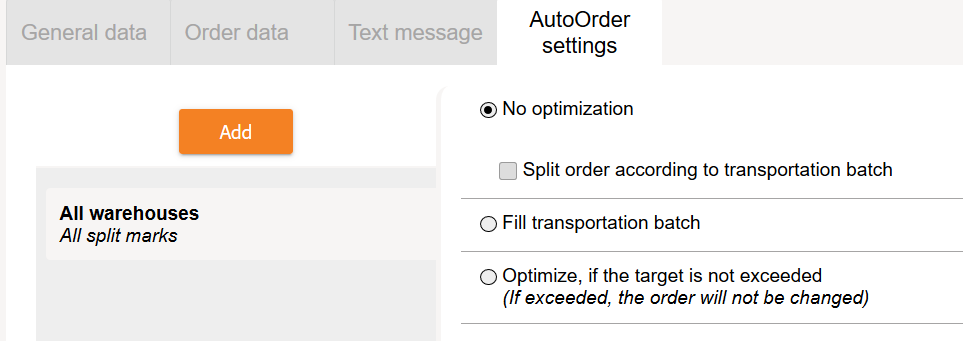
Selection of Auto send settings window in the supplier‘s card has changed:
- Optimization for auto send works only into the increasing side;
- If you want to decrease the order – to optimize into decreasing side, this you can do only by specifying the parameters manually.
- To decrease the number of rows to ... – also possible only by specifying the parameters manually.
Auto send settings window:
- Select „No optimization“.
StockM Update 2020.04.30
- Select „Fill transportation batch”.

1. New setting for calculating buffer by coefficient.
In the Periods or Inventory window when calculating the buffer according to the specified coefficient, the buffer is calculated according to the formula:
New BUF = (BUF - MOQ) * coeff. + MOQ
Since this update, this buffer calculation method has a selection / checkbox “Take into account MOQ” that allows you to select to take into account MOQ or not:
- By default, the check mark is placed and the new buffer calculation formula remains as it was.
- If the check mark is not placed, new buffer formula is:
New BUF = BUF * coeff.
2. Calculation of average sales for lost sales.
Lost sales are only calculated for DTA items with a balance ≤ 3% (buffer + safety buffer). It is checked how many days a week the items met this condition and the number of days obtained is multiplied by the average daily sales. Average sales are calculated at purchase prices.
Until now, average daily sales have been calculated by taking sales over a three-month period and dividing them by a number of days of 3 months without evaluating whether there was a balance in stock during these days. Average daily sales were inaccurate because there was no balance of some items in stock for the entire period. In other words, they could have counted smaller.
To make the calculation of average daily sales more accurate, after the update, they will be calculated by taking sales for a three–month period and diving them by the number of days when the balance or sales were available.
StockM Update 2020.04.23
- Select “Optimize, if the target is not exceeded”.

1. Reservations by date (pto.csv).
There are 2 types of reservations in StockM: from the existing stock in the warehouse and special orders from customers (received in StockM via the pto.csv file).
Since this update, StockM immediately included received pto order in the nearest order to supplier, the date when the order had to be fulfilled was not estimated. In other words, program did not take into account the fact that the customer / buyer does not need these goods now and they can be delivered later with next orders.
Now StockM will check what delivery date of pto is. In the separate field “Activate before X d.” the number of days before the necessary delivery date can be specified, i.e. when the order must become active and can be already fulfilled. If in the field “Activate before X d.:
- nothing is specified, the field is empty, the pto order will be processed immediately and it will be included in the nearest order to the supplier;
- 0 is entered, the goods will be ordered with the last order, which will arrive before the specified delivery date;
- certain number of days is entered, the order will become active in such a number of days before the “Delivery date” and will be included in the next order to supplier after this activation.
2. Verification by uploading data to StockM via Table L11.
When uploading data to StockM via table L11, the information was loaded only when there were no errors. If the program found errors, the information was not loaded. A list of items was displayed to the user and errors had to be corrected.
Since this update, information will be loaded from those rows that do not contain errors, and a list of errors will be shown to the user (errors can be exported to excel as before). Once the errors are corrected, the data will have to be uploaded for specified rows once again by entering information into a new / separate L11 table template.
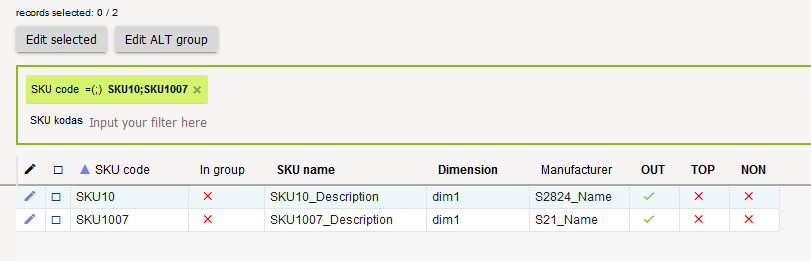
3. New filtering operator in StockM windows.
An additional text field filtering operator has been added to StockM. It allows to specify / enter several values via a semicolon.
Manual optimization window:

Show the optimization parameter, optimization purpose and optimization condition in this window, when you optimize the order manually.
1. Confirmation of supply graphs.
There is a possibility to import the supply graphs in StockM, from the accounting (file scheduler.csv).
All recieved supply graphs from the accounting are confirmed automatically by system, after update.
2. Template of promotion import.
The template of promotion import has changed after update.
Download the newest template from StockM, if you want to import data into promotion.
StockM Update 2020.04.09
StockM update 2019.09.19.
Critical error: "Optimization: purchase price <= 0"
When order is optimized according the amount, purchase prices are checked and if the active goods/items don't have the purchase price, the order is not optimized.
The list will show items with Purchase Price <= 0 for suppliers, for which is set order optimization according the amount.
StockM update 2019.08.01.
- Combining of items into a group of alternative (ALT) items.
Until now, when combining items into the ALT product group, the main item had to be in all active warehouses, and the ALT product was not necessarily present.
This situation created problems in the distribution of items from the central warehouse to the branches. When it was necessary to order a product from a central warehouse, an ALT product was offered to be transported to the branch if there was a sufficient ALT product balance in the center and it was not checked that the branch does not sell the ALT product.
Since this update, the main and alternative items’ codes must be in all storage locations to combine ALT items.
A warning has been made in the confirmation window of combining when saving settings that both main and alternative items will be distributed through the warehouses. Distribution takes place through all warehouses containing at least one product involved in the ALT combination. The message after combining of items will show how many new items (SKU) cards have been created through the warehouses.
2. New setting in SM Admin “Divide product order amount”.
If orders for the supplier are formed frequently, but the delivery / delivery time is long, there is no need to order the entire buffer immediately with the first orders. It is possible to create several orders in one delivery time and thus reduce the amount of ordered goods. In other words, “fill the buffer” not immediately, but in several deliveries (divide the ordered quantity of one item in time over several orders).
After the update, it is possible to enable the setting so that in case of frequent but long deliveries, the entire buffer would not be ordered at once in one order. If at least 2 regular orders can be formed during the delivery time, then a maximum limit is applied to the ordered quantity, which is calculated according to the ratio of delivery frequency and duration and buffer. The maximum quantity also includes a PTO and a reservation so that ordered quantity was not restricted for special needs.
Important: The possibility to use this function has to be agreed separately and setting of this function works company-wide. If necessary, contact the project manager.
1. Removing supplier activity.
Until now, it was not allowed to remove supplier activity if the supplier had active delivery schedules.
After update, when supplier activity is removed, all activities are automatically removed from supplier schedules as well. Supply schedules are not even visible.
If you will set activity on for the supplier, the shedules will be visible but not active - you will need to check and confirm it.
2. New critical notification: „Active items don‘t have active supplier“.
There is created warning of critical error: “Active items don’t have active supplier”. All active items will get into this list (not NA state and not NM state), for which inactive supplier is assigned. Items, which have OUT mover feature, will not be involved into the list.
For such items you will have to assign an active supplier.

3. The reason for changing the buffer, when the user disagrees with the system's suggested buffer.
Earlier, when the user disagreed with the system's suggested buffer, he left the former buffer - the system asked to specify the reason.
After update, the reason will be assigned automatically, when the user will disagree with the system's offer to change the buffer and will leave former buffer.
If another buffer will be specified (not that one, which was recommended by system), you will have to specify the reason.
4. New column in the new orders window: “Notes in new order window”.
In the window “New orders” you can see new column “Notes in new order window”, where you can see information from the field “Notes in new order window” in the supplier card.

