Changes for page NAUJIENOS
Summary
-
Page properties (1 modified, 0 added, 0 removed)
Details
- Page properties
-
- Content
-
... ... @@ -1,121 +1,150 @@ 1 -= StockM Update 2021.01.14 = 1 +(% class="wikigeneratedid" %) 2 += StockM Update 2020.10.15 = 2 2 4 +**~1. Distribution of Safety buffer to stores from the central warehouse.** 3 3 4 - **Assignment ofOUTtype toitemswithALTstatus.**6 +When distributing balances from the central warehouse to stores / branches, the quantity of the Safety Buffer in the central warehouse is not distributed. 5 5 6 - For alternative items (ALT) maybe specified:8 +Since this update, it is possible to specify Safety buffers, which fall into the distribution of balances to branches / stores. If it is necessary to distribute the following quantities, the Safety buffers must be entered / indicated in columns: SB2, SB3 (In the inventory window or on the product card), or the information must be transferred during the data exchange. The quantities indicated in them will participate in the distribution of the balance from the central warehouse. 7 7 8 -* ThetypeOUT fora productthat is taken outftherange.10 +**2. Visibility of lost sales, transfers, overstock and write-offs in StockM.** 9 9 10 - When theALTitemis out of stockinallwarehouses,theitemisdroppedfromhegroupand the status specifiedin theSMAdminisassigned.12 +Since this update it is possible to see last week's lost sales, lost transfers, overstock and write-offs in the StockM window (new option). Now you can now see this information (excluding write-offs and transfers) in your weekly lost sales and overstock reports. New columns in StockM appear in the Inventory window (you only need to open them). 11 11 12 - *The typeCLNfor product on sale,which maybe in the range in the future.14 +If you need to analyze a number of causes / problems, it is possible set such tasks to appear in the User Tasks window. The task would be visible to those managers whose products fall into these lists. A window will open with a list of items, where each item will need to be accompanied by the reasons for lost sales, overstock, etc. 13 13 14 - WhentheALTproduct is outofstockinallwarehouses,the itemis droppedfromthegroupandthe status DTOis assigned.16 +The number of reasons for lost sales, lost transfers, overstock, or write-offs is determined company-wide - you can choose how many reasons you want to analyze. The settings are made by a StockM team. 15 15 18 +To enable Report Analysis in StockM, you must inform a StockM team. At the same time, you will be sent a more detailed description of how to use these reports. 16 16 17 -For ALT items, the OUT type can be assigned: 18 18 19 -* in the ALT items combination window "Alternative SKU" in the "OUT type" column (if you do not see the column in the window, open it via the column visibility selection); 20 -* by uploading it via SM Admin, via template to merge ALT items: Actions -> Merge ALT groups. 21 += StockM Update 2020.09.24 = 21 21 22 - In theolumn “OUT type”nexttothe item it is necessarytoindicate:23 +**Recipients of copy of orders.** 23 23 24 - o“1”to assignOUTto the item;25 +In the past, copies of an order have always been received by the user who sends the order and / or is responsible for the order. The setting was company-wide. 25 25 26 -o “2”ifCLN27 +Since this update, this setting is available on the supplier card. If it is active, a copy of the supplier's order will be sent to the persons responsible for the order and / or who sent it. A copy will not be sent if this setting is inactive[[image:20200824a.png]] 27 27 28 - o “0” to remove theassigned type29 +[[image:20200824.png]] 29 29 30 - [[image:20210114.png]]31 += StockM Update 2020.09.17 = 31 31 32 32 33 -(% class="wikigeneratedid" %) 34 -= StockM Update 2020.12.17 = 34 +**~1. Search in the Order window.** 35 35 36 +In all Order windows (New orders, Placed orders, Sent orders history) a quick filter / search input field "Quick filter" has been created. 36 36 37 -**~1. Change of TOP / NON names in StockM (ABC analysis).** 38 +* The filter / search works immediately with each character entry. 39 +* The filter / search works from all columns. 40 +* If at least one character is entered in the filter / search field, the edges of the field are marked by a green line (filter active) and at the same time all buttons in the order window are switched off (gray color). In other words, as long as the filter is active, the information is filtered in the window - a visible part of the order is only visible and no actions with order can be saved, sent, etc.). 38 38 39 - In StockM, the names TOP / NON have changedin to the widely used ABCanalysis and its usual terms:42 +[[image:image_2020_09_17T13_51_19_877Z.png]] 40 40 41 -* TOP name changed to “A”; 42 -* NON - to “C”; 43 -* Blank rows that were in the “Movers” and “WMovers” columns are now called as “B”. 44 44 45 -The logic of the calculation does not change, everything remains as it was. The names also changed in the reports. 46 46 47 - Columnnamesthat changedin StockM:46 +**2. New type of mark OUT** 48 48 49 -* the column name “Movers” changed to “ABC”; 50 -* Wmovers - to LocABC. 48 +The mark OUT for items to remove them from the range of products was used so far. 51 51 52 - Ifthe itemisnew, you will see"New" inthe "LocABC"column (if the"Newto"datehasnotassed yet).50 +Since this update, it is possible to select the OUT type: 53 53 54 -**2. New column in StockM "Next delivery".** 52 +* the current mark OUT. Nothing has changed. Recommended for use when the product is sold out and removed from the range. 53 +* a new mark CLN. For the items to be sold out that may be kept in the range further on or included in the range later again. The distribution and statuses of the items which are marked CLN operate on the same principle as OUT, but the final status remains DTO everywhere. After the stock balance ends, the mark CLN will be automatically removed. If we later receive the stock balance or some kind of movement of the items into StockM, the status of the items will remain DTO. 55 55 56 - Fromnow on, you canseethe expected delivery dateof the itemStockM. If theitemis inmultipleorders,theearestexpected deliverydateisdisplayed.55 +**3. Mass combining into groups of alternative items (ALT)** 57 57 58 - Thenameofthenewcolumnis "Nextdelivery".Itisvisiblein theInventory,SuppliersSchedulewindowsandon theproductcard.57 +In SM Admin menu (ADMIN -> ACTIONS -> MERGE ALT GROUPS) window there is a draft of the table for mass combining of the items into ALT groups. 59 59 60 - p.s.if you don't see the column, open it through thecolumn selection.59 +[[image:20200918.jpg]] 61 61 62 -(% class="wikigeneratedid" %) 63 -= = 64 64 65 -= StockM Update 2020.11.12 = 62 +* Main SKU code: SKU code of the main item in the group. 63 +* Parameters SKU code: SKU code of the item, which parameters will be assigned to the main SKU. 64 +* Old Main SKU code: if the existing group of items is changed, indicate the existing (old) code of the main SKU in the group. The Main SKU code field must contain the new main SKU code. 66 66 67 - **Return ofoverstocktothe company'scentralwarehouse.**66 +If a new group is being combined, do not specify anything in this field. 68 68 69 - Wepresentanewopportunitytoform return ordersforoverstock items from warehouses / storesto thecentral warehouse.68 +* Alt SKU code: SKU code of alternative item 70 70 71 -I nStockMwindowOrders->CreateOrdersa new"ReturnOrder"sectionhas beencreated.To placeareturn order,youmust specify:70 +Note: If there is more than one ALT item code for the same main SKU code, they must be listed on separate rows, repeating the main SKU code on each row. 72 72 73 -* a central warehouse to which you will return overstock; 74 -* warehouses / stores (and / or warehouse levels) from which returns must be made; 75 -* it is possible to indicate which groups of items will participate in the return (if none is selected, all are considered to be marked), 76 -* from what percentage of the BB indicator (balance and buffer ratio) items have to be returned (less than 100% cannot be specified). 72 +The completed table needs to be imported into StockM. 77 77 78 - Inother words, the percentageindicatesthat the excess items above it are returned.74 += StockM Update 2020.09.03 = 79 79 80 -[[image:20201112.png]] 81 81 82 - IMPORTANT:In order to return theitems from the warehouse / store,it isnecessary to create a supplierwith the same suppliercodeas the warehousecode (Supplier code = Warehousecode).77 +**~1. Additional buffer management setting.** 83 83 84 - Othermandatoryconditions:79 +It is possible to specify a condition for increasing the buffer in the supplier's card: do not increase buffer if undelivered orders present. If the check mark is placed, the addition (IN) during the last replenishment time is checked: 85 85 86 -• the item does not participate in the promotion in the branches / stores from which it is returned; 81 +* if addition was - the buffer is increased. 82 +* if there was no addition, the existing buffer is retained. 87 87 88 - •theproduct does nothave the markofbeingout of range or sold out(OUT,CLN)84 +Since this update, an additional condition is made for increasing the buffer: do not increase the buffer if shipments are not full. When this condition is enabled, not only the fact of replenishment, but also the quantity received is evaluated. The buffer will not be increased if the amount of additions during the replenishment period is less than 0.5 × BUF + Safety Buffer. 89 89 90 -(% class="wikigeneratedid" %) 91 -= = 92 92 93 - =StockMUpdate2020.10.15=87 +**2. Added possibilities to open SKU graph.** 94 94 95 - **~1.DistributionofSafetybuffertostoresfromthecentralwarehouse.**89 +The SKU graph can be accessed by clicking on the graph icon in the line. 96 96 97 - When distributing balancesfromthe central warehouseto stores / branches,the quantity of the Safety Bufferinthe centralwarehouse is not distributed.91 +Since this update, additionally: 98 98 99 - Sincethis update,it is possible to specifySafetybuffers, which fall into thedistribution of balancestobranches/ stores. If it isnecessary todistributethefollowing quantities,the Safetybuffers must be entered /indicated incolumns: SB2, SB3 (In theinventory window or on the product card), or theinformationmust be transferredduring the data exchange. The quantitiesindicated in them will participateinthedistribution of the balance from the central warehouse.93 +* The SKU graph can be opened in the line by right-clicking and selecting “SKU graph”. 100 100 101 - **2. Visibility of lost sales, transfers, overstock and write-offs in StockM.**95 +[[image:20200903a.png]] 102 102 103 - Since thisupdateit ispossibletoseelastweek'slostsales, losttransfers,overstockand write-offs in theStockMwindow(newoption). Now youcannow seethisinformation(excludingwrite-offsand transfers)in your weeklylostsales and overstockreports. NewcolumnsinStockMappear in the Inventorywindow(youonlyneed toopen them).97 +* Once the graph is opened, you can navigate through the graphs of other items in the list from which the graph was opened. Icons have been made in the upper right window of the graph, which can be used to: 104 104 105 - If youneed to analyze a number of causes / problems, it ispossiblesetsuch tasks toappear in theUserTaskswindow.The taskwould be visibleto thoseanagerswhose products fallintotheselists.A windowwill open witha list of items,where eachitem willneedtobe accompanied by the reasons for lost sales, overstock, etc.99 +o [[image:20200903b.png]]– to open the graph of the next item in the list in the window; 106 106 107 - The numberof reasonsforlostsales, losttransfers,overstock,or write-offsis determined company-wide- youcan choosehow manyreasonsyou wantto analyze.Thesettings are made by a StockM team.101 +o[[image:20200903c.png]] – to open the graph of the previous item in the window; 108 108 109 - ToenableReport Analysisin StockM,you mustinformaStockM team.At thesame time,youwill besent a moreetaileddescriptionofhowtouse these reports.103 + o[[image:20200903d.png]]– to capture an opened graph. The graph of the next item will be opened in a new window. 110 110 111 -= StockM Update 2020.0 9.24=105 += StockM Update 2020.08.20 = 112 112 113 -**Recipients of copy of orders.** 114 114 115 - Inthepast, copies of an orderhave alwaysbeenreceived by theuserwho sends the orderand /ors responsiblefortheorder. Thesettingwas company-wide.108 +**~1. Setting: to reduce the quantity ordered by the SKU according to the supplier's balance.** 116 116 117 - Sincethisupdate,thissettingisavailable onthe suppliercard. Ifitis active, a copy of the supplier'sorder will besenttopersonsresponsible for theorder and / or who sent.Acopywillnot besentif this settingisnactive[[image:20200824a.png]]110 +A setting is made, which allows to reduce the quantity ordered by StockM, according to the free balance available from the supplier. If the supplier does not have enough free balance for the desired quantity, the order will be reduced to the balance available from the supplier. 118 118 119 - [[image:20200824.png]]112 +This setting is enabled on the supplier's card and only takes effect when the Supplier's balance of the item is visible in StockM. 120 120 114 +* The supplier's balance (in supplier's units) can be loaded to StockM from the accounting (via supplier_sku.csv file) during data exchange or entered in the StockM in the "Supplier SKU information" window (new column "Supplier balance") 115 +* Each warehouse can order as many units of the same item as are available from the supplier (we recommend using this setting when items are delivered from the supplier to the central warehouse). 116 +* In StockM, the order window also shows the column “Supplier balance”, but already in the basic units of measure (automatically converted into the basic units of measure specified in StockM, if they are different from the supplier units of measure). 117 + 118 +**2. Creating a new item (SKU) card in the Order window.** 119 + 120 +Until now, when creating an order and needing to create a new SKU card, it was only possible to create it in the Inventory window. After creating the card, it was necessary to reload the window of items to add in order the new item would appear in the list. 121 + 122 +Since this update it is possible to create a new SKU card in the Order window: New order -> Add SKU -> New. 123 + 124 +**3. Overstock report: columns of PTO and Reservation.** 125 + 126 +The PTO column in the overstock report (511) has so far shown the total amount of PTO (special orders) and reservation. 127 + 128 +After updating this report, the PTO and reservation will be displayed in separate columns. 129 + 130 +**4. Formation of orders several times a day**. 131 + 132 +There is a need to form orders several times a day, for the same supplier to the same warehouse. 133 + 134 +It is possible now to create orders several times a day (according to the same schedule, only at different times). If necessary, contact the project manager. 135 + 136 +**5. Periods: Buffer calculation based on maximum sales amount.** 137 + 138 +Until now, in the Periods window it was possible to choose: calculate the buffer according to the coefficient; enter the buffer manually; calculate the buffer on the basis of average sales. 139 + 140 + An additional option has been made to calculate the buffer based on the maximum sales amount. If you choose this option, you will need to specify: 141 + 142 +* The period from which the program will take the maximum amount of sales during the supply cycle (RD). If the period is specified too short (<RD), the program will take the buffer at the beginning of the period instead of the maximum sales amount. 143 +* Coefficient - the calculated amount will be multiplied by the specified coefficient (if the amount is not calculated due to an incorrectly specified period, the current buffer will be multiplied by this coefficient). 144 + 145 +(% class="wikigeneratedid" %) 146 += = 147 + 148 +(% class="wikigeneratedid" %) 149 + 121 121
StockM Update 2021.01.14
StockM Update 2020.10.15
Assignment of OUT type to items with ALT status.
For alternative items (ALT) may be specified:
- The type OUT for a product that is taken out of the range.
When the ALT item is out of stock in all warehouses, the item is dropped from the group and the status specified in the SM Admin is assigned.
- The type CLN for product on sale, which may be in the range in the future.
When the ALT product is out of stock in all warehouses, the item is dropped from the group and the status DTO is assigned.
For ALT items, the OUT type can be assigned:
- in the ALT items combination window "Alternative SKU" in the "OUT type" column (if you do not see the column in the window, open it via the column visibility selection);
- by uploading it via SM Admin, via template to merge ALT items: Actions -> Merge ALT groups.
In the column “OUT type” next to the item it is necessary to indicate:
o “1” to assign OUT to the item;
o “2” if CLN
o “0” to remove the assigned type

StockM Update 2020.12.17
1. Change of TOP / NON names in StockM (ABC analysis).
In StockM, the names TOP / NON have changed in to the widely used ABC analysis and its usual terms:
- TOP name changed to “A”;
- NON - to “C”;
- Blank rows that were in the “Movers” and “WMovers” columns are now called as “B”.
The logic of the calculation does not change, everything remains as it was. The names also changed in the reports.
Column names that changed in StockM:
- the column name “Movers” changed to “ABC”;
- Wmovers - to LocABC.
If the item is new, you will see "New" in the "LocABC" column (if the "New to" date has not passed yet).
2. New column in StockM "Next delivery".
From now on, you can see the expected delivery date of the item in StockM. If the item is in multiple orders, the nearest expected delivery date is displayed.
The name of the new column is "Next delivery". It is visible in the Inventory, Suppliers Schedule windows and on the product card.
p.s. if you don't see the column, open it through the column selection.
StockM Update 2020.11.12
Return of overstock to the company's central warehouse.
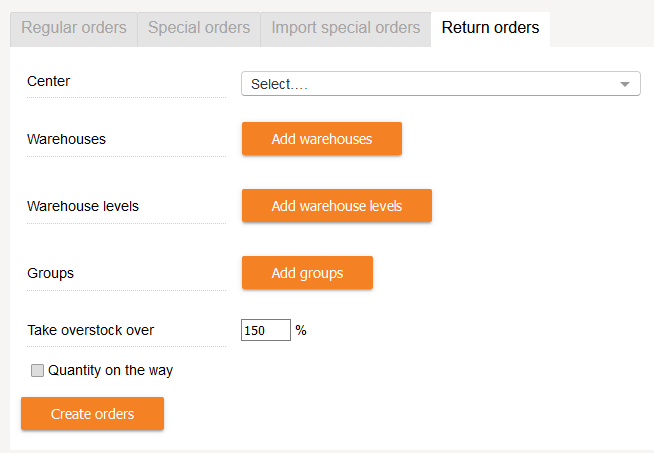
We present a new opportunity to form return orders for overstock items from warehouses / stores to the central warehouse.
In StockM window Orders -> Create Orders a new "Return Order" section has been created. To place a return order, you must specify:
- a central warehouse to which you will return overstock;
- warehouses / stores (and / or warehouse levels) from which returns must be made;
- it is possible to indicate which groups of items will participate in the return (if none is selected, all are considered to be marked),
- from what percentage of the BB indicator (balance and buffer ratio) items have to be returned (less than 100% cannot be specified).
In other words, the percentage indicates that the excess items above it are returned.
IMPORTANT: In order to return the items from the warehouse / store, it is necessary to create a supplier with the same supplier code as the warehouse code (Supplier code = Warehouse code).
Other mandatory conditions:
• the item does not participate in the promotion in the branches / stores from which it is returned;
• the product does not have the mark of being out of range or sold out (OUT, CLN)
StockM Update 2020.10.15
1. Distribution of Safety buffer to stores from the central warehouse.
When distributing balances from the central warehouse to stores / branches, the quantity of the Safety Buffer in the central warehouse is not distributed.
Since this update, it is possible to specify Safety buffers, which fall into the distribution of balances to branches / stores. If it is necessary to distribute the following quantities, the Safety buffers must be entered / indicated in columns: SB2, SB3 (In the inventory window or on the product card), or the information must be transferred during the data exchange. The quantities indicated in them will participate in the distribution of the balance from the central warehouse.
2. Visibility of lost sales, transfers, overstock and write-offs in StockM.
Since this update it is possible to see last week's lost sales, lost transfers, overstock and write-offs in the StockM window (new option). Now you can now see this information (excluding write-offs and transfers) in your weekly lost sales and overstock reports. New columns in StockM appear in the Inventory window (you only need to open them).
If you need to analyze a number of causes / problems, it is possible set such tasks to appear in the User Tasks window. The task would be visible to those managers whose products fall into these lists. A window will open with a list of items, where each item will need to be accompanied by the reasons for lost sales, overstock, etc.
The number of reasons for lost sales, lost transfers, overstock, or write-offs is determined company-wide - you can choose how many reasons you want to analyze. The settings are made by a StockM team.
To enable Report Analysis in StockM, you must inform a StockM team. At the same time, you will be sent a more detailed description of how to use these reports.
StockM Update 2020.09.24
Recipients of copy of orders.
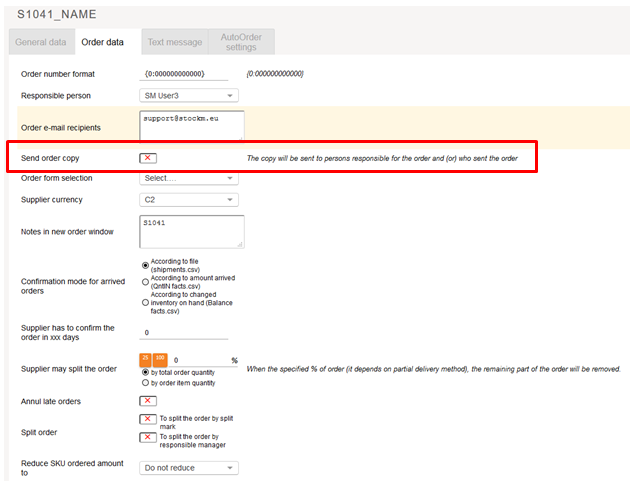
In the past, copies of an order have always been received by the user who sends the order and / or is responsible for the order. The setting was company-wide.
Since this update, this setting is available on the supplier card. If it is active, a copy of the supplier's order will be sent to the persons responsible for the order and / or who sent it. A copy will not be sent if this setting is inactive
StockM Update 2020.09.17
1. Search in the Order window.
In all Order windows (New orders, Placed orders, Sent orders history) a quick filter / search input field "Quick filter" has been created.
- The filter / search works immediately with each character entry.
- The filter / search works from all columns.
- If at least one character is entered in the filter / search field, the edges of the field are marked by a green line (filter active) and at the same time all buttons in the order window are switched off (gray color). In other words, as long as the filter is active, the information is filtered in the window - a visible part of the order is only visible and no actions with order can be saved, sent, etc.).

2. New type of mark OUT
The mark OUT for items to remove them from the range of products was used so far.
Since this update, it is possible to select the OUT type:
- the current mark OUT. Nothing has changed. Recommended for use when the product is sold out and removed from the range.
- a new mark CLN. For the items to be sold out that may be kept in the range further on or included in the range later again. The distribution and statuses of the items which are marked CLN operate on the same principle as OUT, but the final status remains DTO everywhere. After the stock balance ends, the mark CLN will be automatically removed. If we later receive the stock balance or some kind of movement of the items into StockM, the status of the items will remain DTO.
3. Mass combining into groups of alternative items (ALT)
In SM Admin menu (ADMIN -> ACTIONS -> MERGE ALT GROUPS) window there is a draft of the table for mass combining of the items into ALT groups.

- Main SKU code: SKU code of the main item in the group.
- Parameters SKU code: SKU code of the item, which parameters will be assigned to the main SKU.
- Old Main SKU code: if the existing group of items is changed, indicate the existing (old) code of the main SKU in the group. The Main SKU code field must contain the new main SKU code.
If a new group is being combined, do not specify anything in this field.
- Alt SKU code: SKU code of alternative item
Note: If there is more than one ALT item code for the same main SKU code, they must be listed on separate rows, repeating the main SKU code on each row.
The completed table needs to be imported into StockM.
StockM Update 2020.09.03
1. Additional buffer management setting.
It is possible to specify a condition for increasing the buffer in the supplier's card: do not increase buffer if undelivered orders present. If the check mark is placed, the addition (IN) during the last replenishment time is checked:
- if addition was - the buffer is increased.
- if there was no addition, the existing buffer is retained.
Since this update, an additional condition is made for increasing the buffer: do not increase the buffer if shipments are not full. When this condition is enabled, not only the fact of replenishment, but also the quantity received is evaluated. The buffer will not be increased if the amount of additions during the replenishment period is less than 0.5 × BUF + Safety Buffer.
2. Added possibilities to open SKU graph.
The SKU graph can be accessed by clicking on the graph icon in the line.
Since this update, additionally:
- The SKU graph can be opened in the line by right-clicking and selecting “SKU graph”.

- Once the graph is opened, you can navigate through the graphs of other items in the list from which the graph was opened. Icons have been made in the upper right window of the graph, which can be used to:
o  – to open the graph of the next item in the list in the window;
o – to open the graph of the previous item in the window;
o – to capture an opened graph. The graph of the next item will be opened in a new window.
StockM Update 2020.08.20
1. Setting: to reduce the quantity ordered by the SKU according to the supplier's balance.
A setting is made, which allows to reduce the quantity ordered by StockM, according to the free balance available from the supplier. If the supplier does not have enough free balance for the desired quantity, the order will be reduced to the balance available from the supplier.
This setting is enabled on the supplier's card and only takes effect when the Supplier's balance of the item is visible in StockM.
- The supplier's balance (in supplier's units) can be loaded to StockM from the accounting (via supplier_sku.csv file) during data exchange or entered in the StockM in the "Supplier SKU information" window (new column "Supplier balance")
- Each warehouse can order as many units of the same item as are available from the supplier (we recommend using this setting when items are delivered from the supplier to the central warehouse).
- In StockM, the order window also shows the column “Supplier balance”, but already in the basic units of measure (automatically converted into the basic units of measure specified in StockM, if they are different from the supplier units of measure).
2. Creating a new item (SKU) card in the Order window.
Until now, when creating an order and needing to create a new SKU card, it was only possible to create it in the Inventory window. After creating the card, it was necessary to reload the window of items to add in order the new item would appear in the list.
Since this update it is possible to create a new SKU card in the Order window: New order -> Add SKU -> New.
3. Overstock report: columns of PTO and Reservation.
The PTO column in the overstock report (511) has so far shown the total amount of PTO (special orders) and reservation.
After updating this report, the PTO and reservation will be displayed in separate columns.
4. Formation of orders several times a day.
There is a need to form orders several times a day, for the same supplier to the same warehouse.
It is possible now to create orders several times a day (according to the same schedule, only at different times). If necessary, contact the project manager.
5. Periods: Buffer calculation based on maximum sales amount.
Until now, in the Periods window it was possible to choose: calculate the buffer according to the coefficient; enter the buffer manually; calculate the buffer on the basis of average sales.
An additional option has been made to calculate the buffer based on the maximum sales amount. If you choose this option, you will need to specify:
- The period from which the program will take the maximum amount of sales during the supply cycle (RD). If the period is specified too short (
- Coefficient - the calculated amount will be multiplied by the specified coefficient (if the amount is not calculated due to an incorrectly specified period, the current buffer will be multiplied by this coefficient).