Changes for page DUK
Summary
-
Page properties (1 modified, 0 added, 0 removed)
Details
- Page properties
-
- Content
-
... ... @@ -284,12 +284,11 @@ 284 284 285 285 ---- 286 286 287 -== ** When the markOUTissignedtothe item?** ==287 +== **Kada prekei priskiriamas požymis OUT?** == 288 288 289 - Mark "OUT"isassignedto theitemtakenoutfrom theassortment by placing checkmark "OUT" ontheitemcard.Thissignindicatesthatthe item istaken out from the assortmentandtheitemstatuswillbechangedtoNA whenallremainingbalanceoldanditwillno longerbevisibleintheactiveitemswindow.290 - Readmore289 +OUT požymis priskiriamas išvedamai prekei, t.y. prekės kortelėje pažymėjus Out Mover varnelę. Šis požymis rodo, kad prekė išvedama iš asortimento ir kai bus parduotas visas dar sandėliuose esantis likutis prekė būvis bus pakeistas į NA ir ji nebebus matoma aktyvių prekių lange. 290 +Plačiau skaitykite [[Items (SKU) marks>>doc:User_Manual.Assortment_Management.WebHome||anchor="HItems28SKU29marksTOP2CNON2COUT2CNEW" rel="__blank"]] 291 291 292 - 293 293 ---- 294 294 295 295 == **Kada prekei priskiriamas požymis TOP?** ==
- HOW...?
- What settings should be made in STOCK-M if several managers work with the same supplier?
- What should I do if order is not formed?
- What's the difference between regular and special order ?
- Is it necessary to "remove" the activity of the supplier with whom we do not work anymore?
- How to proceed when the supplier's goods are sold out or the supplier is refused?
- How is the supplier's reliability calculated when the supplier delivers items more than it was ordered ?
- What parameters are assessed to calculate reliability of supplier?
- How to set up warehouse information on the order form?
- What should be done to prevent the buffer from the too big decrease?
- Should the buffer be changed when the supply time is prolonged?
- How to change the buffer when changing frequency of the orders?
- Can DTO items be showed not as a surplus if they are used in exposition?
- How "ROI" and "turnover rate" are calculated ?
- At what prices are sales counted?
- When is the PTO used?
- How are priorities for PTO reservation assigned?
- How is an order formed when DTA item is reserved by PTO?
- How is an order formed when DTO item is reserved by PTO?
- How do PTO priorities work?
- WHY...?
- Why is the product today not included in regular order?
- Why does the system offer to order exactly such quantity?
- Why the buffer is changed less than per zone?
- Kokie nustatymai turi būti, kad perskaičiuojant buferį, būtų vertinamas skaičius po kablelio?
- Why changed the buffer?
- When is the item assigned to NA status?
- When the mark NEW is assigned to the item?
- When the mark OUT is assigned to the item?
- Kada prekei priskiriamas požymis TOP?
- Kada prekei priskiriamas požymis OUT?
- Kada prekei priskiriamas požymis NON?
- Kada prekei priskiriamas požymis TOP?
- Kada prekei gali būti priskirta žymė TOP+NON?
- Kada prekei priskiriamas požymis NON?
- Kada prekei gali būti priskirta žymė TOP+NON?
HOW...?
What settings should be made in STOCK-M if several managers work with the same supplier?
A check mark in the "Supplier Edit" window must be placed on both tags for splitting orders.
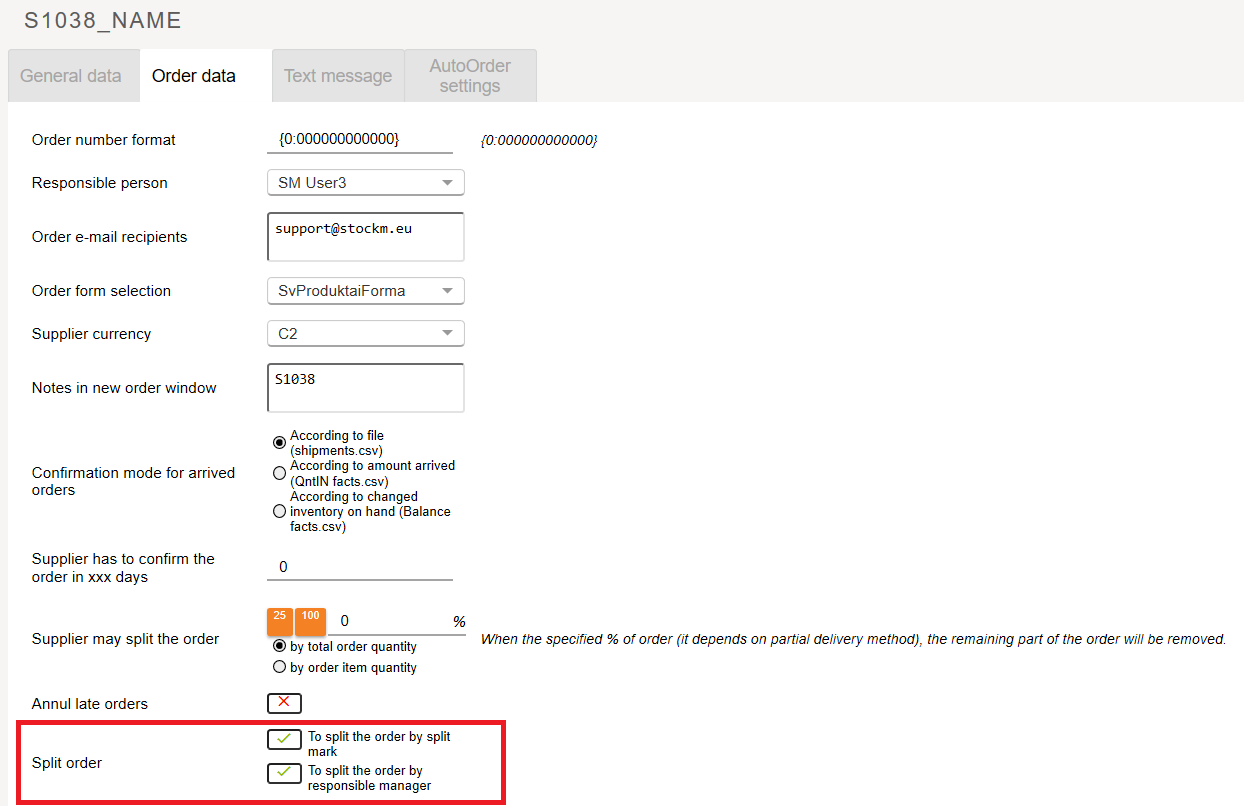
The system will first create orders based on the responsible manager for the products as well as will split the orders according to the splitting tag that is assigned to the items.

For more information about order separations, see the ORDER SPLIT MARK MANAGEMENT RULES
What should I do if order is not formed?
1. Verify that the data exchange has been successfully completed.
2. Check the supply schedule.
3. In the Inventory window, filter out the supplier's items with the value "Order" > 0.
4. If the data exchange has completed successfully, the order had to be formed according to the supply schedule. Therefore, in the window of Inventory, you see that there are items to be ordered – form a new order manually. Orders → Create order.
What's the difference between regular and special order ?
A regular order is formed according to the STOCK-M calculated demand, the quantities that the system will add into the order can be seen in the Inventory window. Ordered quantities will be seen as "On the way" after sending a regular order. Regular orders can be of two types:
-a regular order formed by the system according to the supplier's schedule.
-a regular order is formed manually. If an order is not created, even though it had to be created or the order has to be sent at other time than indicated in the schedule.
Special Orders – are formed manually only, such orders are used to order quantities not under the system, for example, for the first (primary) distribution of the item, for a one-time promotion campaign agreed with the supplier, and so on. They can also be of two types:
-a special order with a quantity on the way. Used when we want the ordered quantity to be visible and the system to assess it by forming regular orders. Ordered quantities will be seen "On the way".
-a special order without quantity on the way. Used when the ordered quantity does not have to effect on quantities of regular orders. Ordered quantities will not be seen as On the way".
For more information about orders, see ORDERS MANAGEMENT
Is it necessary to "remove" the activity of the supplier with whom we do not work anymore?
If supplier is changed, it is necessary to "remove" activity for the old supplier of the item. If the activity is not "removed" and the goods are assigned to another supplier, orders will be formed for the new assigned supplier. Even the remaining activity of the old supplier will not effect on any process, the old supplier will be visible in the windows of active suppliers and supply schedules, thus, will distort the real situation.
How to proceed when the supplier's goods are sold out or the supplier is refused?
There are two options:
- all the items from that supplier are derived from the assortment and no items on the same codes will not be purchased from other suppliers. In this case, you must delete the schedule and remove activity tag from that supplier. The system will ask if all the items of that supplier need OUT mover tag to be put on? Select YES.
Read more about items Items (SKU) marks TOP, NON, OUT, NEW
- you will not work with that supplier, but items on the same codes will be purchased from other suppliers. Delete the schedule and remove activity for the old supplier, but when system will ask if all the items of that supplier need OUT mover tag to be put on – Select "NO".
Read more about Change of supplier's order formation or change of the item supplier
How is the supplier's reliability calculated when the supplier delivers items more than it was ordered ?
Any deviation (too small or too large quantity delivered) from the sent order reduces the supplier's reliability. For example, if you ordered 100 lines and the supplier delivered 120 lines – supplier's reliability is 100/120 i.e. 83%
What parameters are assessed to calculate reliability of supplier?
The exact and time-delivered order, i.e. the delivered order lines and the actual delivery time are assessed.
How to set up warehouse information on the order form?
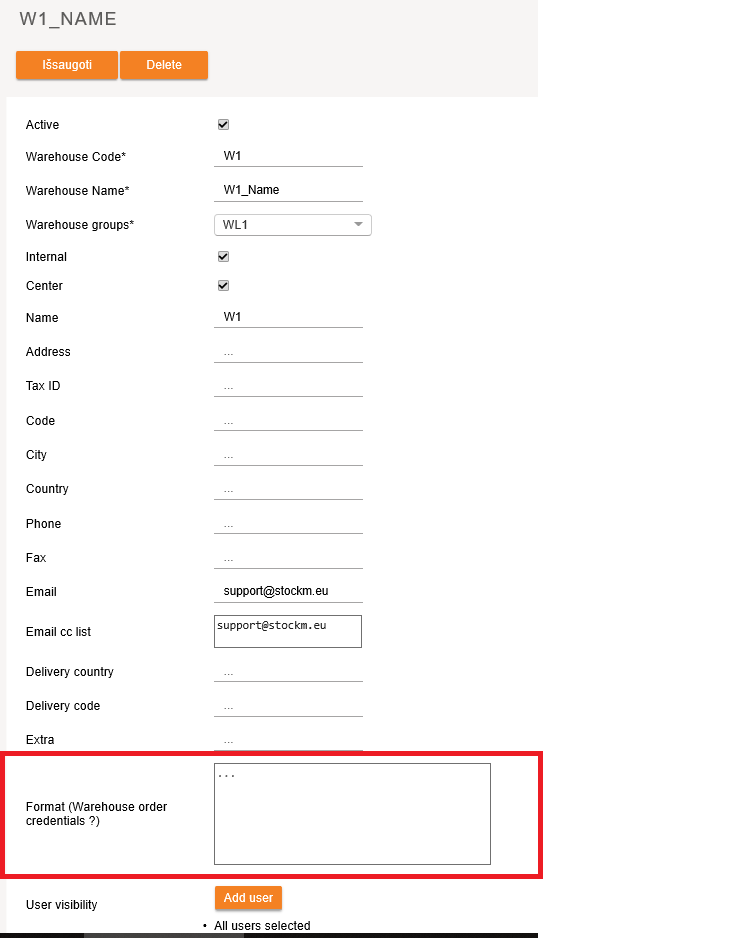
The warehouse information is set on the order form by entering it in the "Format (Warehouse order credentials)" field in Warehouse Settings when connected via SM Admin. You can specify all necessary information as warehouse name, address, etc. which will be shown on the order form.
What should be done to prevent the buffer from the too big decrease?
It is necessary to determine the minimum buffer and the system will not allow the buffer to decrease below the specified limit. Minimum buffer is the value at which the buffer can be reduced (buffer cannot be less than MinBuf or MOQ). The minimum buffer is changed on the item card. The minimum buffer is used when sales may be smaller, but it is necessary to keep in store more. For example, tyres, they can be sold as 1 pc, but most often the customer buys the whole set, i.e. 4 pcs. In this case, after setting the minimum buffer of 4, whatever the sales are, the system will not allow the buffer below 4.
Should the buffer be changed when the supply time is prolonged?
There are two options:
-When the supply cycle is prolonged (thinning shipments), because according to the old supply cycle a minimum order amount each time is not reached (the system evaluates it). In such a case if time of supply is increased up to 2 times, recalculation of the buffer is not required.
-If minimum order amount is reached every time at existing shorter supply time, in this case if time of supply is increased, the buffer should be increased by the same coefficient used to increase the supply time (using the 'Period' function).
How to change the buffer when changing frequency of the orders?
In case of the significant change of the supply cycle it is necessary to recalculate buffer in order not to run out of goods.
Formula for calculating the new buffer:
(Old buffer - MOQ) * coefficient + MOQ = new buffer
We calculate the coefficient by the formula:
New supply cycle / old supply cycle = coefficient
For example:
1. Order frequency 2 times per month (14 days)
Supply time 14 days
Old supply cycle 28 days
2. Order Frequency 1 time per month (30 days)
Supply time 40 days
New supply cycle 70 days
Coefficient: 70/28 = 2, 5
NOTE
-when the supply cycle is increased, the buffer must always be changed to ensure that the goods do not run out.
-when the supply cycle becomes shorter it is necessary to analyze each case separately, as the decision to recalculate the buffer depends on how much the cycle is shortened;
- you do not need to recalculate the buffer when you reduce the order frequency due to unformed orders, it will be managed by the system.
Can DTO items be showed not as a surplus if they are used in exposition?
No, because the DTO item is the one that is ordered only on a special order. If the product has been brought, sold and will not be ordered again, then it should be left as DTO. If the product has been brought, sold and will be ordered again – the item is DTA. If you do not want the buffer to change – the buffer must be fixed in Min. buf = BUF = Max. buf.
How "ROI" and "turnover rate" are calculated ?
Turnover is the ratio of sales and inventory (at purchase prices). Red line in Inventory Dynamics reports window shows turnover rate as times per year (the higher figure, the better result), i.e. how many times per year the inventory of the company "turns over" . Turnover you can find in Dashboard (window Today/ Home) is calculated in days (the lower figure, the better), i.e. for how many days you will have inventory on stock.
ROI is the ratio of margin and average inventory, inventory is calculated at purchase prices. The discounts are not known, therefore, the figure is just indicative to track trend. ROI is showed as a blue line in the Inventory Dynamics reports window.
At what prices are sales counted?
All the values in STOCK-M, except the margin, are calculated at purchase prices.
When is the PTO used?
The PTO reservation is used when there is no balance of the item in the warehouse where the reservation is made. PTO reservations are received in the STOCK-M in PTO. csv file.
How are priorities for PTO reservation assigned?
The priorities are applied to the distribution of the goods from a central warehouse to branches. In central warehouse is stored quantity reserved by PTO, until the branch that has this reservation has a schedule for delivery. Even if it is supplied to other branches before, the PTO quantity is not being delivered to them. The date of the PTO reservation is not yet assessed. That is, the branch having delivery schedule closer may receive the goods (take the entire balance from the central warehouse) even it places PTO reservation later.
How is an order formed when DTA item is reserved by PTO?
When the item is DTA, the formed order quantity is rounded to the lower USQ side because the demand difference of the PTO will be delivered from the regular balance. (Buffer – Balance + security buffer + reservation + PTO).
How is an order formed when DTO item is reserved by PTO?
When the item is DTO, the formed order quantity is rounded to the full USQ / MOQ to the bigger side because the quantity delivered must be sufficient for the full order execution. Anyway, the difference should not be, because the manager must pay attention to the MOQ and USQ when accepting the order and do not accept the order for a smaller quantity. Therefore, the delivered product under the special order should be sold immediately and should not enter the balance.
How do PTO priorities work?
PTO priorities depend on the supply chain and are valid for the warehouse in which the PTO reservation is made, priority works through one supply chain:
1. When a PTO is in a regional warehouse and the supply to it takes place from a central warehouse: PTO quantity is reserved in the central warehouse and is not delivered into other warehouses by regular orders. With the nearest supply, the item will be delivered to the PTO-holder warehouse. If the PTO is from more than one warehouse, the priority is set according to the supply schedule: the goods will first receive the warehouse which has more early supply schedule.
2. When a PTO is in the warehouse for which the item is supplied by an external supplier, the priority is not set up, all the PTO items have priority and are added to the regular order formed to the supplier according to the schedule.
WHY...?
Why is the product today not included in regular order?
CONDITIONS for the item to enter the regular order:
- The item must have status DTA.
- The supplier must be set to SKU.
- The supply schedule must be set and active.
- The order date must be today.
- The buffer must be set for the item.
- There must be a demand for an item.
Why does the system offer to order exactly such quantity?
The following indicators shall be evaluated to calculate quantity to be ordered :
1. Status.
2. Buffer.
2. Balance.
3. Quantity on the way.
4. Reservation.
5. Security buffer.
6. Special order.
7. MOQ.
Ordered quantity = Buffer – Balance – Quantity on the way + Reservation from existing balance + Security buffer + Spec. order
Why the buffer is changed less than per zone?
When the buffer is close to or equal to MOQ - the other buffer calculation algorithm is valid, which raises or decreases the buffer based on average sales calculated. This calculation applies to slow-moving items so that they do not run out of the stock until the nearest delivery.
Kokie nustatymai turi būti, kad perskaičiuojant buferį, būtų vertinamas skaičius po kablelio?
Kintamo kiekio prekėms BUF ir MUK gali būti reikšmė su skaičiumi po kablelio. Kad buferio perskaičiavimas vyktų vertinant skaičius po kablelio matavimo vieneto kortelėje neturi būti varnelės ties „Reikšmė turi būti sveikas skaičius“. Į kortelę patenkama: Redagavimas → Matavimo vienetai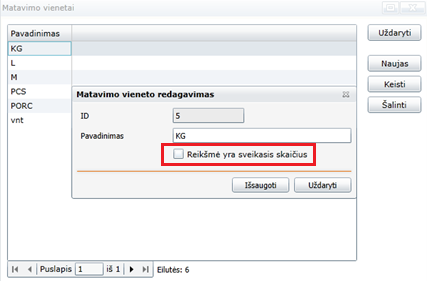
Why changed the buffer?
If the check marks "automatically reduce and increase buffers" in the supplier's settings are placed, buffers will automatically increase or decrease according to the supply cycle (RD, GD). The system checks the dominance of the balance in zones every day – if the balance during the supply cycle will dominate in the red area, the balance will be increased, if in green - reduced. If there are no check marks placed, the system will propose to increase or decrease buffer, but the final decision to change the buffer or not will be done by the manager.
When is the item assigned to NA status?
When data of the item is not renewed for more than 30 days, the item is showed in system warnings. Clicking the button "Fix" makes the status of all such items NA.
Read more in Items (SKU) marks.
When the mark NEW is assigned to the item?
The mark NEW is assigned to all newly occurred items and is assigned for 3 months.
Read more Items (SKU) marks
When the mark OUT is assigned to the item?
Mark "OUT" is assigned to the item taken out from the assortment by placing check mark "OUT" on the item card. This sign indicates that the item is taken out from the assortment and the item status will be changed to NA when all remaining balance is sold and it will no longer be visible in the active items window.
Read more Items (SKU) marks
Kada prekei priskiriamas požymis OUT?
OUT požymis priskiriamas išvedamai prekei, t.y. prekės kortelėje pažymėjus Out Mover varnelę. Šis požymis rodo, kad prekė išvedama iš asortimento ir kai bus parduotas visas dar sandėliuose esantis likutis prekė būvis bus pakeistas į NA ir ji nebebus matoma aktyvių prekių lange.
Plačiau skaitykite Items (SKU) marks
Kada prekei priskiriamas požymis TOP?
TOP požymis priskiriamas DTA prekei, jei ji patenka į 80% apyvartos generuojančių prekių sąrašą. TOP požymis gali būti priskirtas ir prekei jau turinčiai kitą žymę.
Plačiau skaitykite Items (SKU) marks
Kada prekei priskiriamas požymis NON?
NON požymis priskiriamas DTA prekei, jei ji patenka į 2% suminės apyvartos generuojančių prekių sąrašą. NON požymis gali būti priskiriamas ir prekei turinčiai OUT arba NEW žymę.
Kada prekei gali būti priskirta žymė TOP+NON?
Toks atvejis gana retas. Jis yra įmanomas, kai įmonė įveda labai daug naujų kortelių. TOP prekių sąrašas formuojamas iš visų DTA prekių, su visais požymiais. Formuojant NON prekių sąrašą į jį patenka visos DTA prekės išskyrus DTA prekes su žyme NEW. Pvz. Jei įmonėj yra 1000 SKU DTA prekių, iš kurių 300 SKU yra naujos prekės su žymė NEW – TOP sąrašas bus generuojamas iš visų 1000 SKU, o NON sąrašas bus generuojamas iš 700 SKU. Тaigi TOP sąrašo gale esanti prekė gali patekti ir į NON sąrašą.
Plačiau skaitykite Items (SKU) marks